Our work.

What was wrong, what we did and what changed, with what each customer agreed to share.

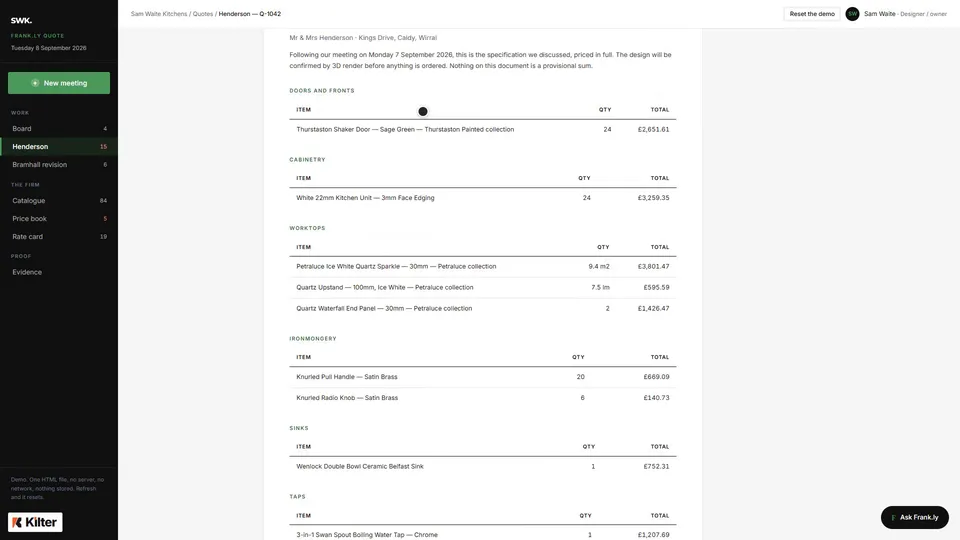
SW Kitchens’ quote in Frank.ly Quote, with the proposed lines sorted by how sure it is.
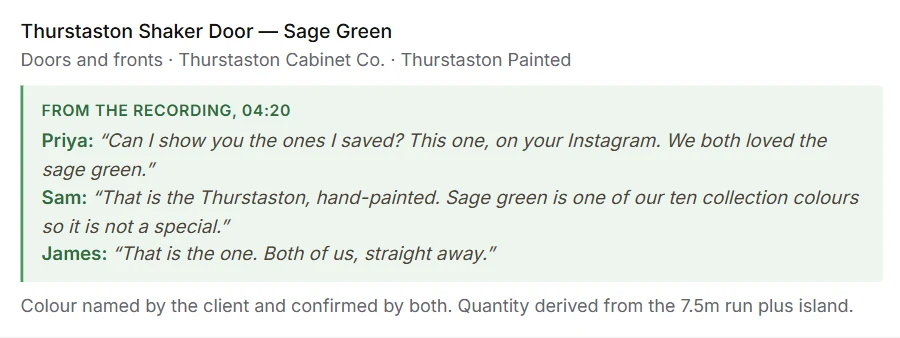
One proposed quote line, with the sentence from the meeting that produced it and its timecode.
One proposed line, the sentence that produced it, and when it was said.

Built, with the customer now

SW Kitchens. A recorded design meeting becomes a priced quote, most of the way done.

Kitchen design and fitting, West Kirby.

The evening of listing and retyping becomes a review, and the designer’s time goes back to the client. Nothing is committed until a person has checked every line.

The problem

  • Every quote was retyped from a phone recording of the site meeting, from memory and notes.
  • Doors, units, worktops and appliances come from separate suppliers on separate price cycles, so every quote meant checking the price lists again.
  • Quantities went through an installation spreadsheet by hand, with the fitter’s day rates laid over the top.

What we did

  • Started from Frank.ly Quote and tailored it to SW Kitchens: their catalogue, suppliers, rates and house style.
  • The meeting recording is read against that catalogue. Every proposed line carries the sentence that produced it, who said it and a timecode.
  • Accept, amend or reject each line. Changing a quantity moves the fitting hours, the margin, the VAT and the deposit together.
  • Stale prices are flagged against each supplier’s own cycle, with a chase email drafted per supplier. The software sends nothing.
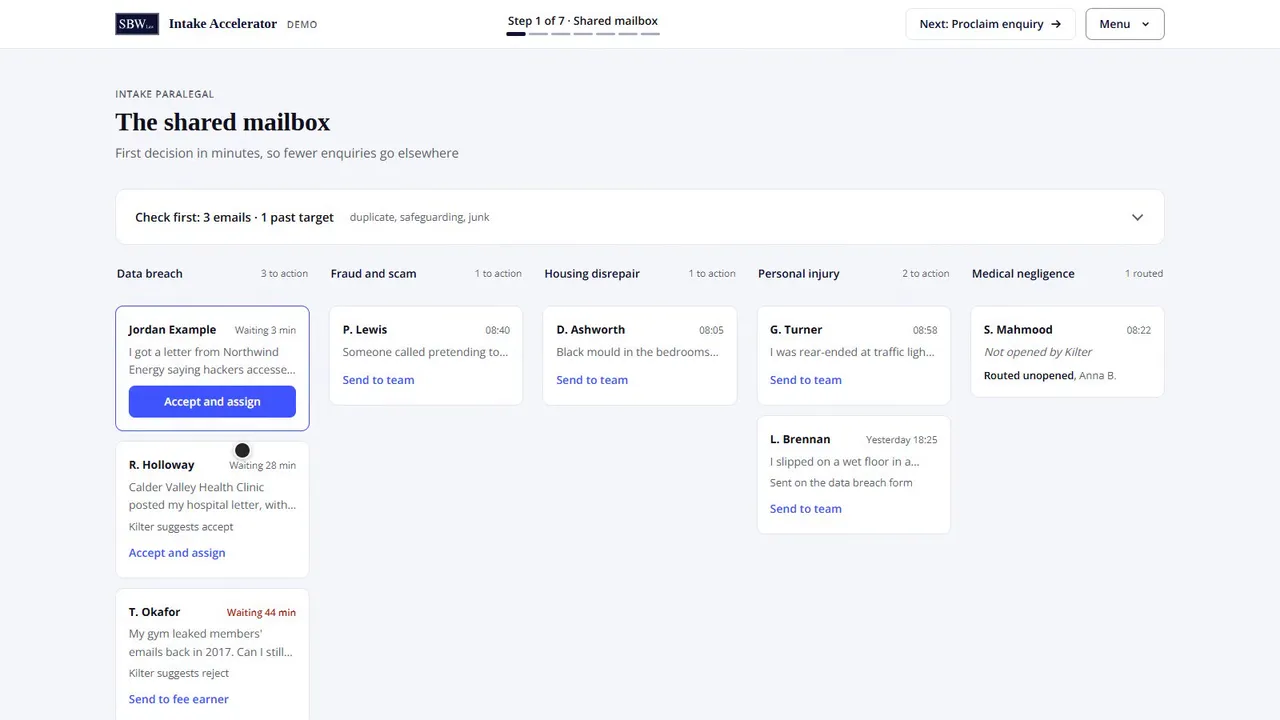
The SBW shared mailbox, with each enquiry sorted by practice area.
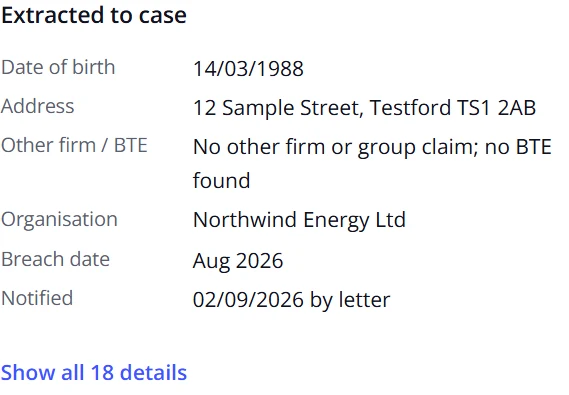
The details taken from the intake call and written to the case.
The intake call, turned into the case details, ready to check.

Demonstrated, pilot being scoped

SBW Law. A website enquiry becomes a signed, case-ready client, with nobody retyping it.

Solicitors, UK.

SBW saw the whole journey working on their own process, and a pilot on data breach claims is being scoped. Every name and detail in the demonstration is made up.

The problem

  • Website enquiries landed in one shared mailbox, and each was read and accepted or rejected by hand.
  • An accepted enquiry was retyped into Proclaim. Then the client was phoned, the signing pack set up and the ID checks chased, all by hand.
  • Accepted enquiries dropped away before sign-up, and nobody could see why.

What we did

  • Mapped the journey with them around the three numbers they care about: the cost to win a client, the profit per case and how long a case takes to get going.
  • Built and demonstrated a working system that sits between the tools they already use: it read and sorted the mailbox, wrote the enquiry into Proclaim and turned the intake call into the case details.
  • The signing pack went to Adobe Sign while the client was still on the phone. ID checks ran on signature, and the letter of claim was drafted for a fee earner to approve.
  • Staff made every decision. Outlook, Proclaim, Adobe Sign and CreditSafe all stayed.
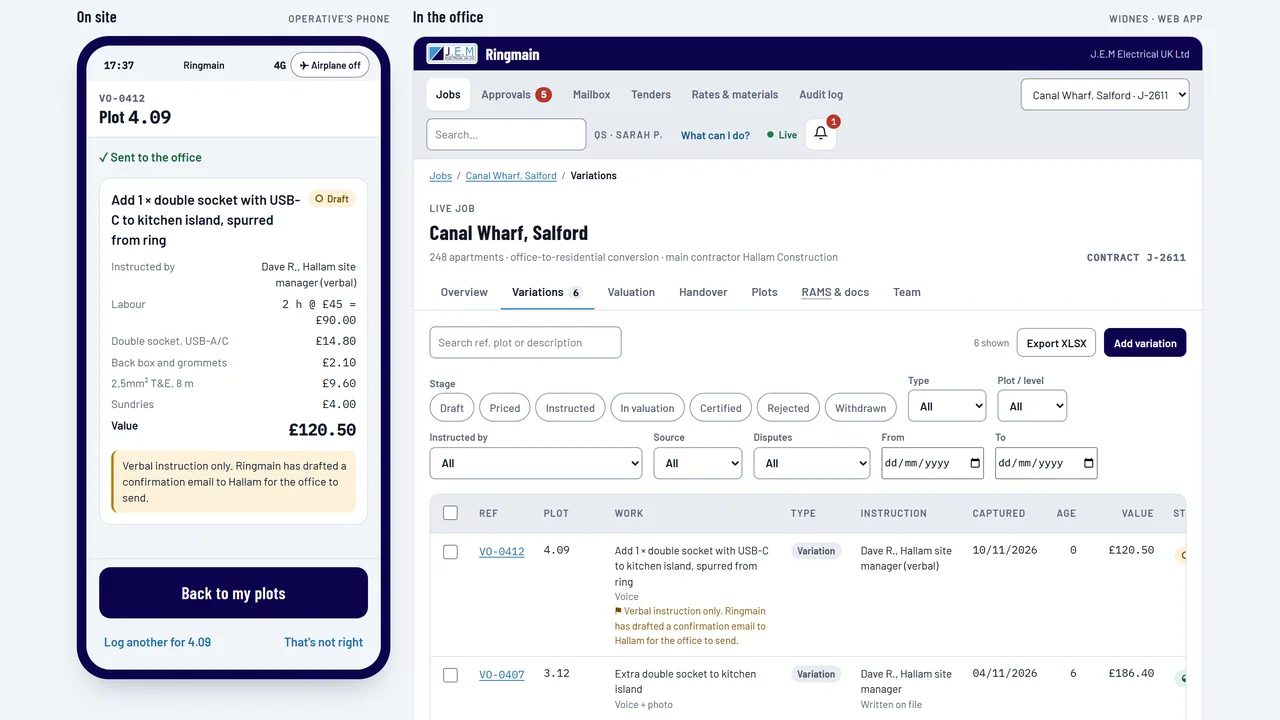
Ringmain: a variation recorded on the phone, and the same variation at the top of the office register.
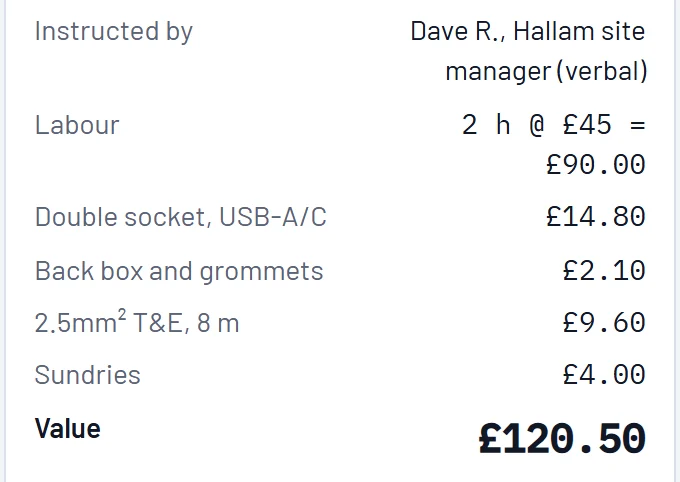
The priced lines on the phone: who instructed the work, labour, materials and the value.
One voice note, priced from the rate card before the electrician has left the plot.

J.E.M Electrical UK Ltd

Being built for JEM

J.E.M Electrical. An extra done on site is recorded once, then priced, claimed and handed over.

Electrical subcontractor, Widnes.

A working demonstration follows one job from the phone to the application, and the full build is under way. The figures JEM will judge it on are being measured first, so the result written here will be a number. Every job, name and figure in the demonstration is made up.

The problem

  • Extra work is asked for on site, often by word of mouth, and has to survive until the monthly application before anyone is paid for it.
  • An instruction that was never confirmed in writing is hard to claim, and harder to defend when the main contractor pushes back.
  • Handover packs are checked certificate by certificate, plot by plot, and a gap found late holds up the pack and the retention behind it.

What we did

  • Started from Frank.ly Construction and are building Ringmain on it for JEM: their rates, their words, their brand.
  • An electrician records the job once on a phone, as a voice note and photos against the plot, with or without signal. It reaches the office priced from JEM’s rate card.
  • Where the instruction was only verbal, the confirmation email to the main contractor is drafted ready to check. The office sends it, and the reply is filed as the written instruction.
  • Instructed work goes into the next application for payment, and anything still waiting is listed beside it. Each plot’s certificates are checked and the gaps named before the pack goes out.
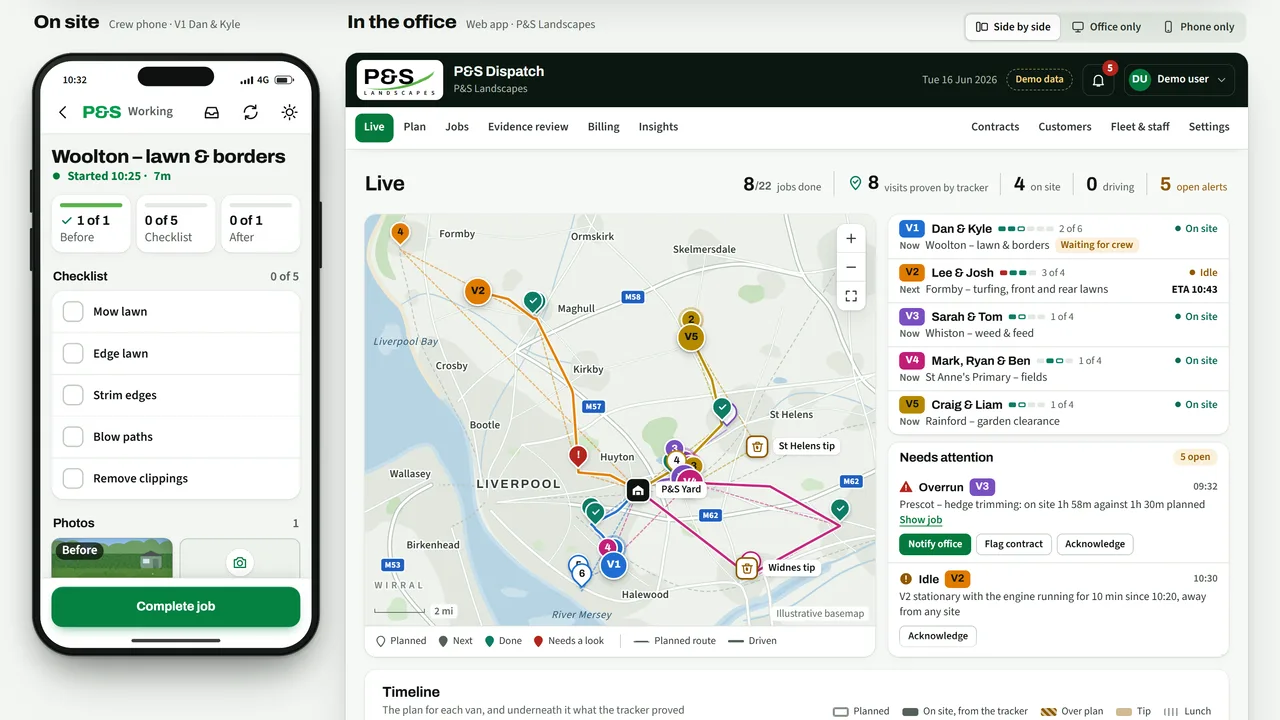
P&S Dispatch: a crew lead working through a job on the phone, beside the office view of every van against the day’s plan.
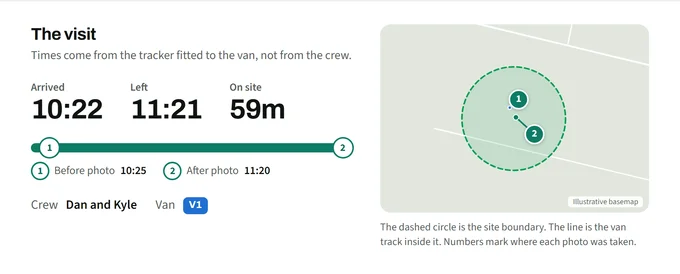
The visit on a proof-of-service page: arrived, left and time on site, from the van tracker.
When the crew arrived and left, from the van tracker, on the page the customer sees.

Being built for P&S

P&S Landscapes. Every visit is proven by the van tracker, then billed from that proof.

Grounds maintenance and landscaping, North West.

A working demonstration follows a day from the plan to the invoice, and the build is being scoped with P&S. The figures they will judge it on are being measured first, so the result written here will be a number. Every customer, job and figure in the demonstration is made up.

The problem

  • Each van’s run has to fit crew skills, site access times, green waste and the weather, and a day that goes wrong is hard to see from the office.
  • When a customer queries a visit or a bill, the proof that the work was done is spread across phones, paper and memory.
  • Contracts are priced on time on site, but nobody can see the time each one really takes, so nobody can see which ones make money.

What we did

  • Designing P&S Dispatch around the trackers already fitted to the vans: a back-office app for planning and billing, and a phone app for the crews.
  • The tracker shows when a van arrived, how long it stayed and when it left. The crew lead adds before and after photos and a checklist on the phone, with or without signal.
  • A visit the tracker and the crew agree on becomes an invoice line with a proof-of-service link the customer can open. Anything that does not add up is held for the office and never billed on its own.
  • Tomorrow’s runs are re-planned in one click, and time on site from the tracker shows which contracts earn their price.

Tell us what’s slow, broken or annoying.

You get a fixed price for fixing it, in writing, before any work starts.

0151 345 6650 [email protected]

Based in Cheshire, working across the UK. The desk is staffed 24/7, every day of the year.

Tour